
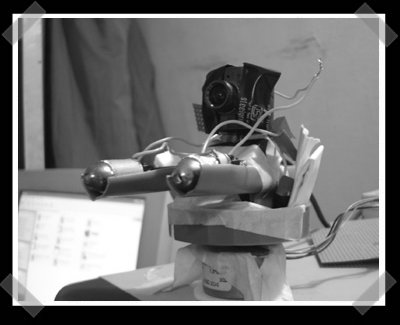
[ashish] is still having fun with his lasers. His latest hack is a dual laser based tracking camera. He mounted his camera to a simple parallel port controlled stepper motor. Essentially, if the camera loses track of either laser, it tracks to locate the lost edge of the object. I’d probably go with IR to reduce the chance of retina damage…


15 thoughts on “Laser Camera Tracking”
Leave a Reply
Please be kind and respectful to help make the comments section excellent. (Comment Policy)








I wouldn’t. Red lasers make you look away if they shine into your eyes. IR ones just burn away your retina without you noticing. I know which one I’d prefer…
I’ve worked with high powered lasers for several years.
Infrared is just as dangerous, if not more dangerous, to your eyes than visible light. There is no such thing as an “eye safe” wavelength; it will be absorbed in your retina or your cornea, depending on wavelength. Damage is possible to both.
Visible is probably safer than invisible wavelengths, because at least you blink. Class I lasers are weak enough that you *probably* won’t do permanent damage to your eye because of the speed of your blink reflex. All lasers must still be treated with respect.
Do not look into laser with remaining eye.
I just wish he would’ve realised the code for this,
http://ashishrd.blogspot.com/2007/01/real-time-color-based-object-tracking.html
they should probably encase the sensor on the sumo robot. i forsee it breaking off as soon as the other robot goes up the ramp
Although infrared light has less energy per photon than visible light (due to its longer wavelength), it can indeed be more harmful to your eyes. Since IR is not registered by the eyes, your pupils will not contract leaving your retinas fully exposed to the light. Its always a good idea not to stare directly into IR lasers, IR spotlights or other bright sources of IR light.
confuted, you’re mixing up class 1 and class 2. Class 1 is unconditionally safe, you can stare into it all day. Class 2 won’t cause permanent harm before you can blink or look away, but if you intentionally look into the beam you can damage your eyes. Most laser pointers are 3B or 3R. Class 4 is for things like cutting lasers…
In some cases, IR beams are safer than visible because they won’t be focused to a point on your retina as easily (due to chromatic aberration).
class one lasers are weak OR fully encased, dvd burner lasers are 300mw, but fully encased, and therefore class I. ir does not penetrate the outer layer of the eye, but does cause heating, to which the eye is very vulnerable. lower powered ir lasers would logically be safer for accidental, momentary exposure than visible, due to the fact it would take quite a while to warm up your entire eye to a damaging temperature.
well, otoh, your cornea has less blood flow than your retina, which makes it more vulnerable to heating.
I’d forgotten the “high power but encased” exception for the class-1 rules. That does confuse the matter a bit.
One thing that I should point out in the ‘eye-safe’ discussion, is that not all IR is created equal to an eyeball. The range from 700 up through about 2000nm passes through to cornea and is focused onto your retina just as well as visible light is, but you have no idea is is there until you can’t see through that part of you eye (although often people won’t notice even quite huge holes in their vision, case in point is the hole where you optic nerve comes in–there is a bling spot there but your never notice it).
Beyond 2000nm light is absorbed pretty well in your cornea, which is much less prone to damage because the light isn’t focused down to an almost diffraction limited spot as it would be on your retina.
Regardless, I wouldn’t recommend shining IR lasers in anyone’s eyes, eye-safe wavelength or not. For applications like this where you are worried about hitting spectators in the eye, just keep the power
Add a motion detector that “wakes” the unit with an air powered paint ball gun and your one step away from a job with DARPA. You could load the gun with pepper rounds and you have a less then lethal defense drone.
A. do NOT use lasers. Use some collimating lenses and a bright LED. you can get the intensity way down and STILL get the desired effect.
It blows my mind how many hackers dont use lenses because they are afraid of optics.
“I’d probably go with IR to reduce the chance of retina damage…”
HOLY CRAP !
IR is more dangerous than visible light to the eye when speaking of lasers !
Your eye will not see the laser, thus your iris will not close, and your retina will absorb all the laser energy !
Seriously be careful of what you say :/
Just a quick comment: I agree that sticking to a lower power red is probably safer than operating at the 800-900nm (VNIR) region as the blink reflex is kind of handy! Using a source at 1500nm is considered ‘eye-safe’ as the cornea will absorb the light but then you need to use much more expensive cameras as silicon is no longer sensitive (cuts off at around 1000-1100nm).
I am wondering about those in cab cameras that are 30 cm from the cabbies face allday while he is driving around. It is usaully mounted above the rearview mirror. I know they are IR cameras but is this kind of IR camera dangerous if the driver is exposed to it at least 12hours a day 6 days a week.
No one has been able to give me any reliable info about these cameras, just to say they think they are safe. Are they please if you have any info email me. Thank you.
excellent post