A few weeks ago, we put out the call for participation for this year’s 2026 Hackaday Supercon, taking place in Pasadena, CA this November. Today was going to be the deadline, but like you, we often let things pile up and put things off, so we’re extending another two weeks until August 26th.
Which is not to say that we haven’t heard from a ton of you! We’re psyched to see so many familiar Supercon regulars on the list, but we also love to see first-timers give talks. We try to make sure that new folks get their time to shine, so if you’ve never given a Supercon talk before, or if it’s been a few years, take this as your cue to present in front of the friendliest audience of like-minded hackers around.
This year is Hackaday’s tenth in-person Superconference, and to celebrate we’ve gotten a larger venue, so more folks can watch the talks live. We’ll be running two tracks as always, and you have your choice of a 20-minute or 40-minute slot. Presenters get in free, and we’ll get you an early-bird ticket rate the submission, so don’t delay and register for your slot today! Or at least before August 26th, because we won’t extend the deadline twice.
Oh, and if you’re interested in tickets, swing by Hackaday about this time tomorrow — we’ll have some news for you.
There was a particular treat at the recent Electromagnetic Field event in the UK, as [Tim Hunkin] delivered a talk on the history of arcade machines. Given that he’s something of an engineering hero for his many years of delighting us with machines, it’s definitely worth a watch.
He has a special interest in arcade machines given that he runs a pair of arcades featuring his own creations. Part of the history tour explains the influence some machines have had on his creations, from the early automata he starts with, through to the Pachinko machine that graces Novelty Automation in London. We’re introduced to Victorian saucy film viewers, one-armed bandits, and pinball machines, and along the way the secret of that most British of machines, the penny falls, is revealed. We particularly like the rare electromechanical Pepper’s Ghost style video game cabinets he describes.
A few years ago now we took a trip to Novelty Automation, and wrote a profile for its creator. If you’re ever in London or Southwold, we suggest you do too. The video from EMF is below the break.
Over the years I have been to many hacker camps and done a lot of very cool things, but BornHack 2026 brought me something entirely new: Radio. By which I don’t mean radio in terms of amateur radio, LoRa, or whatever, but Radio. Broadcast radio, because the camp had a special event FM radio station for the first time. And because in a previous life I spent an inordinate amount of time in my university’s student radio station and have the Radio Voice to prove it, I was totally there for it.
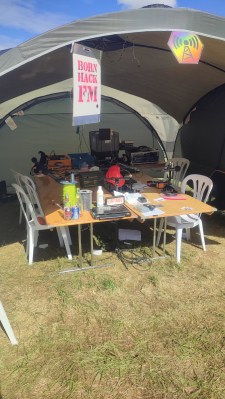
The BornHack Radio nerve centre.
For a hacker camp, one of the special things about BornHack Radio was unexpected, that it was entirely analogue. No online streams, the only broadcast was over the air, 5 watts ERP from a vertical antenna stuck on a mast at the highest point of the Hylkedam scout camp site. I don’t know whether any of the residents of the isle of Funen listened, or what they made of it, but it certainly reached as far as the two closest towns.
The other unexpected feature of the station was that it had no music licensing. Personally I viewed this as an asset, because it forced the programming to be hacker-focused rather than suit the musical tastes of whichever people are enthusiastic enough to be DJs. I sincerely hope they don’t get a music licence at future events, speech-only gives it a special quality.
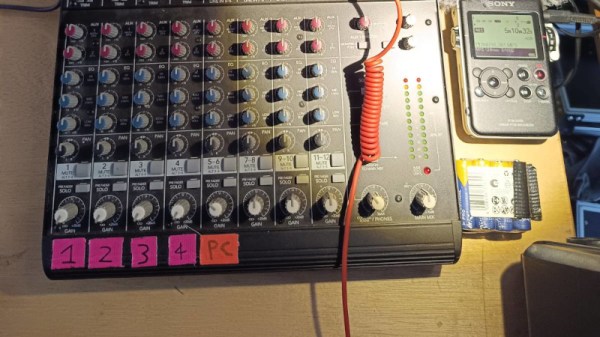
The studio for an analogue station like this one can be surprisingly simple, in that it’s a mixing desk to bring all the different microphones and other inputs together and set the levels, and not a lot else. the whole thing was in a Coleman shelter on the main drag through the camp, so as studios go it could have been quieter. Programming varied from talk shows through interview shows, a live feed from the speaker tent — is this the first ever Hacker Jeopardy broadcast? — and a beautifully done robotic numbers station which I suspect may also have been part of one of the on-camp games.
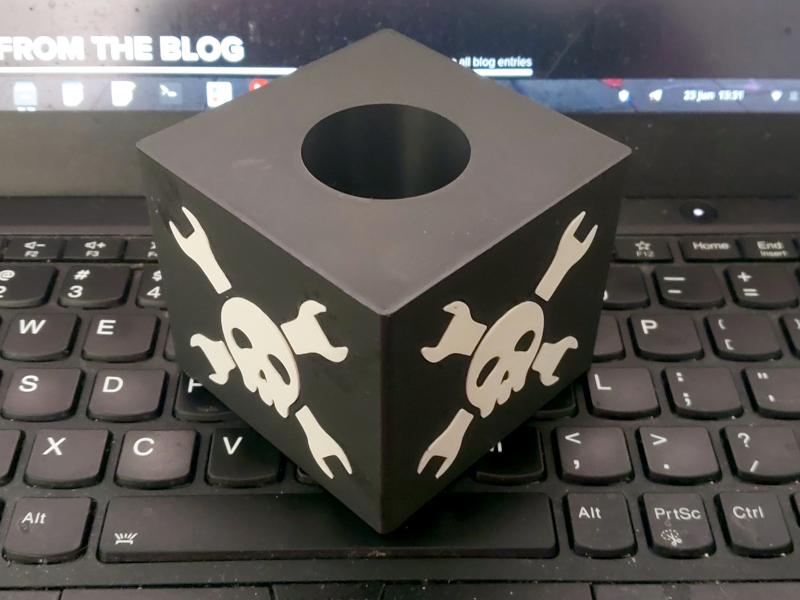
The thing that struck me most in my first foray into radio journalism was how straightforward it was. Wander the camp with microphone (complete with fluffy windshield and 3D-printed Hackaday cube), drop the results into Audacity, and a remarkably straightforward editing process compared to video. Last time I did this it involved 1/4″ tape and a razor blade.
So that was BornHack Radio, a new experience at a hacker camp both for those of us who ventured forth on the airwaves, and I hope also for the listeners. A format in which the live shows disappeared into the aether rather than having an online afterlife gave the whole thing a freedom rarely found in 2026. I really hope this isn’t the last time I break out the fluffy microphone at a hacker camp.
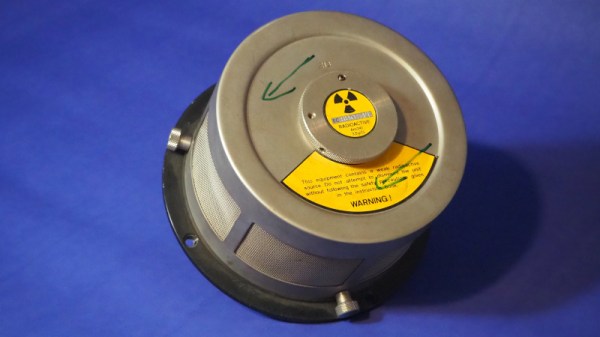
At the 2024 Electromagnetic Field event in the UK, some awkward items turned up at the swap meet: radioactive sources. Fortunately there was [Tryst] at hand, who works in the nuclear industry, so they were safely collected. At this year’s EMF he was back, with a talk about what happened next.
It seems they were an industrial version of the smoke detectors we’ll all be familiar with, containing the same Americium alpha emitters, but in greater quantity. Their path from industry to hacker camp is purposefully shrouded in mystery to avoid future incidents happening because people are scared to come forward, but it seems that but for a bit of post-Brexit regulatory chaos they would normally have been taken back by their Danish manufacturer for disposal.
We’re treated to a fascinating deep dive into radioactive source regulation and just what these sources are. In short, they’re not too dangerous as they are, but what makes them a worry is that they can easily be dismantled and their contents released. Ingestion of alpha particle emitters is a particular worry, so they must be kept safe and accounted for. Which leaves [Tryst] with a set of radioactive sources that sit in a regulatory grey area and can’t easily be disposed of. He ends by asking for suggestions as to how they might be used, of which we favor a true random number generator.
Light-hearted interludes aside, this is a cautionary tale for all of us who delight in digging through technological junk, and we are lucky that our community includes people with the expertise to do something about items like these. The full talk is below the break.
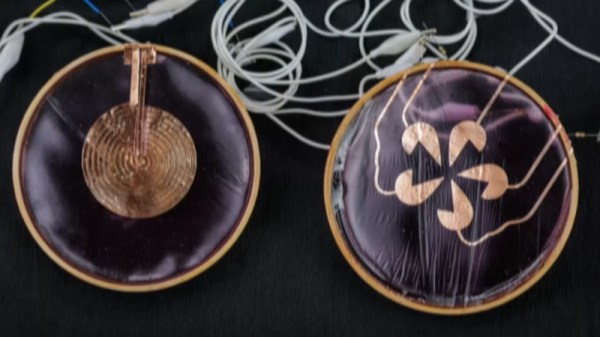
Flexible printed circuit boards are a fascinating technique for making electronics venture beyond the two-dimensional, but surprisingly they’re not something many of us have worked with. [Jessica Stanley] gave a talk at the recent Electromagnetic Field event in the UK, exploring the different ways to make your electronics bend.
She starts with an overview of flexible electronics, detailing the techniques used with conventional polyimide substrates and etched copper. We’re particularly enamoured of a stretchable PCB made by coiling a flexible circuit round a piece of elastic. Since she’s looking for techniques accessible to everyone that don’t either cost a fortune or require dangerous chemicals we look at conductive paint and electrolysis, before arriving at using a vinyl cutter to create adhesive traces.
We’ve no doubt all noticed that flexible PCBs can be ordered from the usual fabrication houses at a price, but the value in this talk lies in reminding the viewer that this is not the only path. She demonstrates well that simple flexible PCBs can be within the reach of almost anyone, which is perhaps the encouragement needed for people to try this medium. The full talk is below the break.
Radios were once big complicated appliances, full of warm valves and paper-wrapped capacitors, all humming and glowing to capture signals from the aether and spit them out of a speaker. Every component was chosen to build the radio to suit a particular purpose.
These days, we have altogether fancier technology that lets us build radios that can be reconfigured on the fly; software-defined radios, if you will. [Anders Nielsen] has been exploring how to build a high-performance SDR recently, and came to Hackaday Europe 2026 to tell us all about it.
There was once a race to put out cameras with ever higher numbers of megapixels to snare customers eager to take the highest quality digital photos. These days, we know that things like optics, processing, and finer qualities of an image sensor are all very important beyond pure resolution. But, for a time, companies behaved as if megapixels mattered over all else.
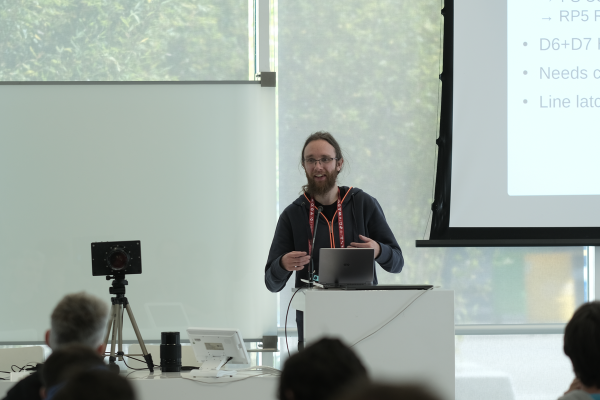
But what if you could go farther—shooting not millions, but billions of pixels in a single image? That’s precisely what [Yannick Richter] came to Hackaday Europe to talk about, covering his Project Gigapixel build.