Posted Apr 20th 2008 7:22AM by Will O'Brien
Filed under: gps hacks, misc hacks

[
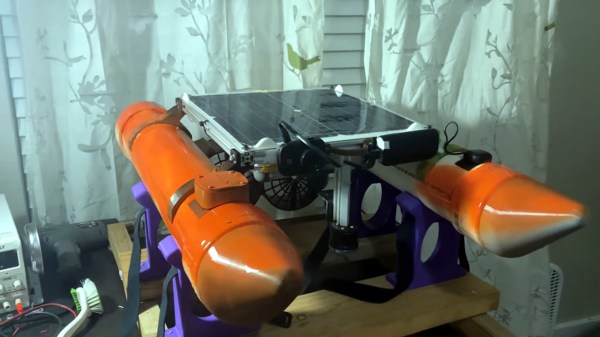
Gabriel] put together an impressive writeup of his autonomous catamaran,
Atlantis(PDF). It was certainly done as an academic project, but there's a thorough explanation of the math logic behind the control systems. The heart of the boat was a waterproofed Pentium laptop with a CAN bus parallel interface used to talk to everything on-board. Sensors included GPS, wind, hull speed and rudder angle. In case the site can't handle the load, I've mirrored the 1.4MB PDF
here.
Posted Mar 13th 2008 2:01AM by Will O'Brien
Filed under: gps hacks

Since water blocks the radio frequency used for GPS triangulation, GPS is considered pretty useless for SCUBA divers. Apparenlty some of them are
finding it useful to waterproof off the shelf units for tracking the beginning and end of dives. (Dives in open water often involve currents that can really move you along.) To avoid any wiring, a floating case is used. When the diver wants to grab a waypoint, he/she lets the gps surface for a short while to acquire a fix. Then the diver can pull it back down and mark the waypoint or record the coordinates.
Posted Feb 24th 2008 7:15PM by Will O'Brien
Filed under: digital cameras hacks, gps hacks, misc hacks

It's been a
while since we talked about putting a GPS on top of a D200. [Rick] sent in his
latest version. He used a nice 20 channel sirf III gps from spark-fun, a cheap D200 remote cable and a few parts to send the NMEA sentences down the wire. The biggest improvements include taking the $100 Nikon cable out of the mix and swiping power from the camera for the GPS board. All the info is there, but I had to seriously stare at his wiring instructions for a while despite the low parts count. I like to see actual circuit diagrams!
Posted Dec 10th 2007 9:41PM by Will O'Brien
Filed under: gps hacks, handhelds hacks

[dgoeken] sent in his
Magellan 3100 hack. The device runs Windows CE 5.0, and mounts as a standard flash drive. Since everything is easily accessible, it's just a matter of replacing and modifying the appropriate files. According to the GpsPassion
message board, some are finding his guide useful for other models of Magellan GPS. So far he's added a file manager, media player and upgraded the Points of Interest file. The site is slightly bandwidth challenged, so I've mirrored his hack process
here.
Posted Oct 4th 2007 2:37PM by Fabienne Serriere
Filed under: gps hacks, misc hacks, wireless hacks

[superlopez] sent in
this detailed article (mirrored
here and
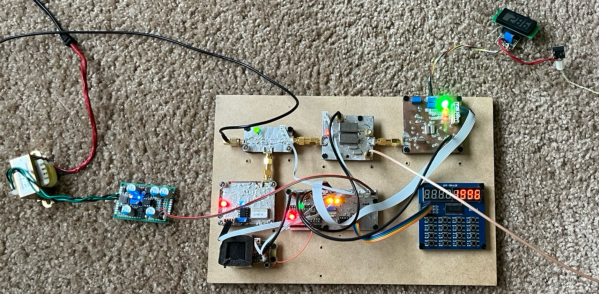
here) which describes how to build a GPS and GLONASS (the Russian version of GPS) receiver. The resulting device is gigantic compared to one of those
tiny bluetooth USB GPS units, but the ability to build one's own receiver is one of those post-apocalyptic skills I sure would like to have. The creator of the article [Matjaz Vidmar] aka [S53MV] also has pages on
Packet-Radio (PKT) transceiver improvements (
PKT gets my vote for the best post-apocalyptic technology, and the only believable technology featured in the Transformers movie), and a more sophisticated homemade
frequency counter than the one featured
earlier this summer.
In 2005 we featured a
from-scratch GPS receiver as well, thought the project site seems to be down. If your GPS unit just needs a better antenna, check out [Will]'s
how-to from last year.
Posted Sep 13th 2007 11:00PM by Will O'Brien
Filed under: gps hacks

[leatix] sent in
this one after seeing the weather balloon logger the other day. In this case, it's built around a Mega8, stores the log on a MMC/SD card and runs on a LiIon battery. Translating it was a bit problematic for me, but give it a shot if you feel lucky.
Posted Sep 11th 2007 11:00PM by Will O'Brien
Filed under: gps hacks

[Stefan] sent in
this data logger that was built for a weather balloon project. It's a very clean design that logs to a 64KB eeprom, can transmit its location via SMS through a cell phone and trigger a camera based on position if needed. The site has a tarball will full schematics and source - mod away.
Posted Aug 18th 2007 11:36PM by Will O'Brien
Filed under: gps hacks, misc hacks

[Nick] caught [Alex]s
GPS enabled AVR, so he sent in his project using the same Telit GM862 module. Rather than depend on an external AVR, he wanted to use the on-board python interpreter. Apparently, documentation is a bit sparse, so he put together a
good write-up on developing python for the device. Since the GPS unit takes up the com port previously used for debugging info, he added a hardware python debugging board to speed development.
Posted Jul 15th 2007 10:31PM by Will O'Brien
Filed under: cellphones hacks, gps hacks

[Alex] sent in some of his
latest work. He interfaced some not so cheap components to give an AVR GPS and GSM I/O. For now it can read the GPS position and send text messages. Thanks to the GPS/GSM module, the schematic is pretty simple - anyone with basic soldering skills and a desire to put a dent in their credit card can probably build this. (Programming the AVR is probably the most difficult task)
Posted Feb 25th 2007 11:50PM by Will O'Brien
Filed under: gps hacks

We don't normally chase after commercial products, but when I ran across this guys
work, I was impressed. My favorite has to be this solar powered GPS logger. It logs your trek to a SD card and it's oh so tiny. Other notable projects include a li-poly battery backpack for charging USB devices. (Li-Poly batteries require some specialized charging)
Posted Dec 25th 2006 12:40AM by Will O'Brien
Filed under: cellphones hacks, gps hacks, handhelds hacks, wireless hacks

Hack-A-Day friend [
Limor] AKA [ladyada] has been promising a portable RF jammer for a while. guess what
she sent me for Christmas? The Wave-bubble is a self tuning RF jammer - good for around 20 feet of RF enforced peace. (It outputs .1-.3 watts) With a pair of less efficient antennas, it even fits inside a pack of cigarettes. She'll never sell these because the FCC would come-a-knockin, but if you've got some major skills, you might be able to build one. (I'm going to believe her take on this, I've seen her work in person and it's some damn fine stuff)
Merry Christmas! Get your
Design Challenge entries in today!
Posted Aug 21st 2006 9:06AM by Will O'Brien
Filed under: gps hacks
Kevin Zeits sent in his diy Nikon d200 gps cable and hot shoe gps mount.
Nikon sells it for $150, but has a 3 to 6 month eta. Ok, it's really just a ttl to rs-232 converter with proprietary connectors - but I love tagging photos with gps info. Now if only I could do this for my canon rebel xt. (It would take a firmware hack at the minimum) If you're not blessed with a d200, check out gpsphotolinker.
Posted Jul 2nd 2006 12:00AM by Eliot Phillips
Filed under: gps hacks
A Radiosonde is an inexpensive sensor package that's intended to be used with a weather balloon for atmospheric measurements. The device transmits data in the 403 MHz band after being launched and they usually aren't recovered after use. You can pick them up for very little money on eBay so [Nick] thought they might work well as a low cost GPS tracker. Unfortunately the Radiosonde doesn't transmit standard NMEA GPS data, but GPS doppler measurements. It's hard to determine what those are actually useful for. Nick did find one other paper documenting an unsuccessful attempt which he has posted to his site. So now Nick is looking for some help either making the data more useful or coming up with a functional device that's just as inexpensive. Anyone got any leads?
Posted Dec 27th 2005 12:30AM by Eliot Phillips
Filed under: gps hacks
This Russian site has all the details needed to upload new maps to a Magellan eXplorist 300, 200, or 100. Inside the battery case are four pads that can be used for serial communication. You will have to use a MAX232 to shift the voltage levels. Since this occupies the battery space you'll need to provide power as well. This can be tapped from a USB port. Once the cable is built you can download waypoints using OziExplorer.
[thanks Chris, Cary for corretion]
Posted Nov 3rd 2005 11:00AM by Eliot Phillips
Filed under: gps hacks
Automatic Position Reporting System (APRS) is used to transmit location and other real-time data over amateur radio frequencies. [Scott Miller]'s OpenTracker project is designed to encode the NMEA data from a serial GPS receiver for transmission. It doesn't have to be used for GPS telemetry though, you could hook up a weather station or any other remotely located project. Scott has boards, parts and even full kits available.
Next Page >
hack a day serves up a fresh hack each day, every day from around the web and a special how-to hack each week.
send us your hacks
have a hack you'd like to see here? tell us about it
Most Commented On (60 days)
Recent Comments