
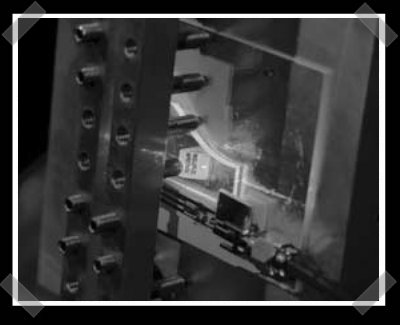
I found this on [hackedgadgets] and checked out the paper describing the project. I’m not sure if it will generate any truly usable graphics any time soon, but the technology is pretty interesting. It combines six video channels and uses acoustic frequencies and tiny but simple looking transducers to vibrate the crystal that channels a laser to generate the hologram. (If I read that paper correctly) Surprisingly, a single nvidia chip generates all six channels for the system. Annoyingly, there’s a lack of info on MITs site, but there’s a nice group of images under the multimedia link of this article.


5 thoughts on “Acoustically Generated Holograms”
Leave a Reply
Please be kind and respectful to help make the comments section excellent. (Comment Policy)









The transducer that they use is tiny, but far from simple. To give you an idea, a product I make (laser gyroscopes for the military) uses a single channel linbo3 modulator, and it costs us about $300 a piece to make them… The process is actually very similar to making IC’s only instead of growing on silicon we use the niobate substrait.
Also, the audio frequiencies was in an older system (using an ao modulator, although even then the audio freqiencnies is somwhat misleading for reasons I won’t get into) this one runs at 200mhz which is then modulated at frequiencies of over a ghz depending on what channel is being used.
Also, as it is it is only monochromatic (green), which will definantly hamper its viability. There was a 2 year estimate for when they will have a RGB one working quotes in the last article…
In any case, I would greatly prefer to see a true holographic topology used for making 3d displays, as opposed to the moving screen or stacked screen that is currently being used.
i remember seeing this demo’ed(video documentation) years ago at an international symposium of display holography at lake forest college, it blew me away! at the time, the computational work was being accomplished by a cray supercomputer, so only the privileged few could indulge in working with acoustically generated holography.
Green may be a hard hurtle.. Look at LED’s took almost 20 years to get past red/green/yellow/inferred. Its a very interesting article though.
This is basically an extension of the work the late Steve Benton did quite a while ago at the Media Lab. It’s rather amusing that a single GPU is doing the computations at this point (the original system used a Connection Machine and several fiber links).
Nice idea but difficult to scale to a practical level.
Wasn’t one of the mechanical television designs based on this principal?